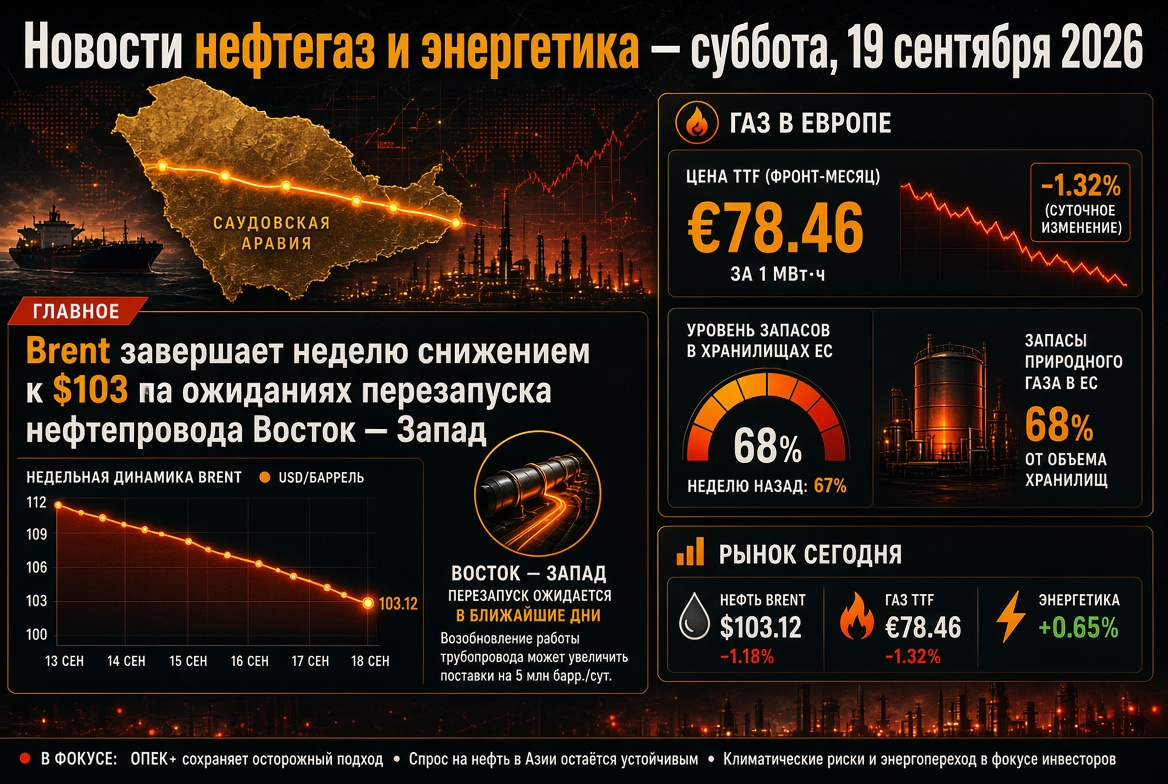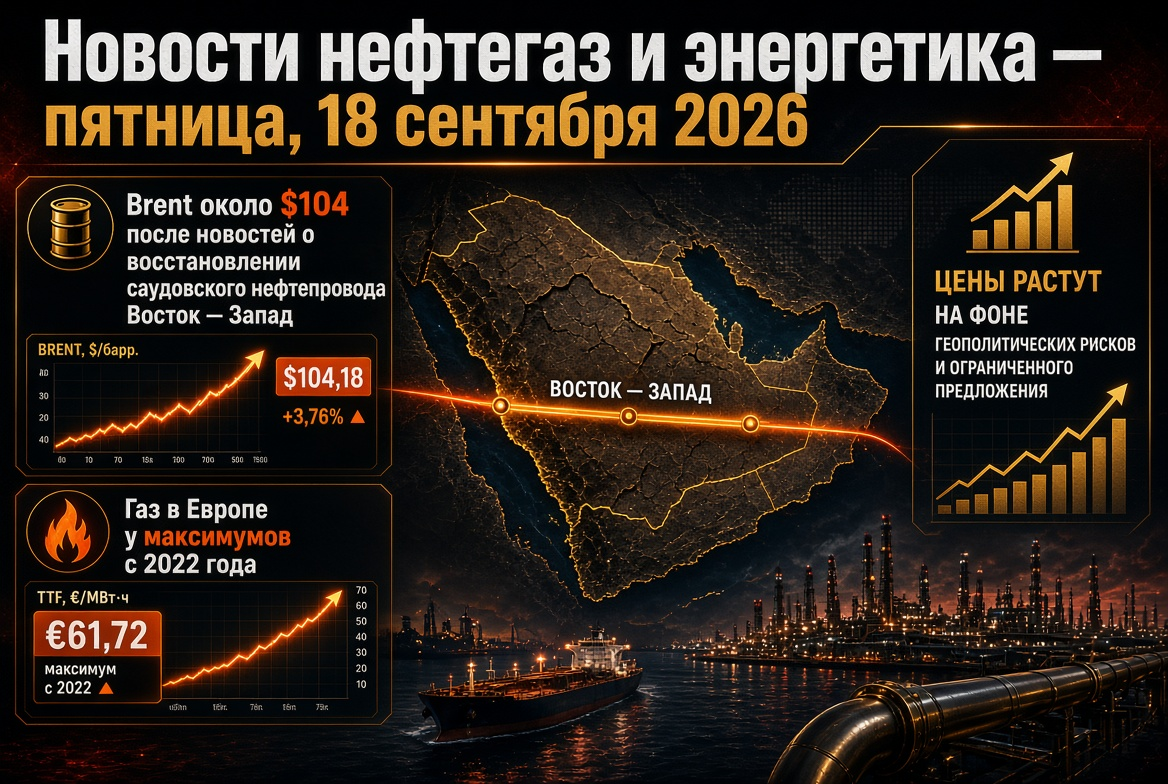
Energy and Oil & Gas News for July 26, 2026: Brent Retreats to $97 After Breaking $100, TTF Gas Above €63/MWh, Shutdown of CPC, Gasoline Export Ban in Russia Until Year End, Newcastle Coal, Electricity and Renewable Energy. Overview for Investors and Participants in the Energy Sector
The global fuel and energy complex is concluding the third decade of July with heightened volatility. Oil prices for Brent, which broke the $100 per barrel mark on Thursday for the first time in nearly two months, lost some gains on Friday, retreating to $97. Nevertheless, the commodity sector recorded an increase of over 10% for the week. European gas at the TTF hub has stabilized above €63/MWh—the highest level since January 2023. Against this backdrop, a major corporate-regulatory news item for the weekend was the decision by Russian authorities to extend the complete ban on gasoline exports until the end of 2026. Below is a detailed overview of key events in the oil, gas, coal, and power sectors for investors, fuel and oil companies, and energy market participants.
Key Highlights by Sunday Morning, July 26, 2026
- Oil: Brent hit a two-month high around $102 on Thursday, closing above $100, but corrected by approximately 4% on Friday, settling at $97 per barrel. WTI gave back about half of its six percent gain, trading near $88-$89.
- Market Dynamics: Brent has gained about 30% over the month and over 40% year-to-date. The weekly summary indicates a rise of 10-12%.
- Gas: TTF futures surpassed €63/MWh—an all-time high since January 2023; representing an increase of over 45% since early July and nearly doubling year-on-year.
- Logistics: Shipments of the Caspian Pipeline Consortium in Novorossiysk have ceased, while Kazakhstan has reduced its production.
- Russia: The gasoline export ban has been extended until the year's end; diesel fuel restrictions will be lifted gradually as the market recovers.
- Coal: Newcastle coal remains around $130 per tonne amid restrained demand from India.
- Electricity: A contract between OpenAI and Georgia Power for 3.2 GW secures the data center's status as a new driver of electricity demand.
Oil Market: Risk Premium Onboard But Not Sustained
The oil market has been trading based on military reports rather than supply and demand balances for five weeks. The breach of $100 for Brent followed Houthi attacks on two Saudi tankers in the Red Sea—events that expanded the risk zone beyond the Strait of Hormuz and raised questions about alternative routes for Saudi exports. The Friday correction can be attributed to two primary reasons: oil continues to flow through Middle Eastern routes, with some tankers sailing with transponders switched off, and technical indicators indicating overbought conditions demanded a pause after the fastest monthly rally since 2022.
Supporting Factors for Prices
- Limited navigability in the Strait of Hormuz, traditionally accounting for about one-fifth of maritime oil trade.
- Threats to Red Sea ports: Riyadh warned on Saturday of potential hazards near Yanbu—a terminal capable of exporting millions of barrels daily.
- Stopping Kazakhstan's exports through CPC, removing over 1% of global supply from the market.
- Rising freight and insurance rates being reflected in refinery purchase prices.
- Extended shipping routes: Asian buyers are considering transporting Saudi oil through the Suez Canal and around Africa.
Constraining Factors
- The U.S.–Iran negotiation track is not formally severed: both sides confirm continued contacts mediated by Oman and Pakistan.
- China's interest in de-escalation: disruptions in the Persian Gulf impact the world's largest oil importer.
- Free capacities in OPEC+ and the ongoing recovery of quotas.
Geopolitics: Dispute Over Navigation Rules in Hormuz
The key narrative of the weekend is not military but legal. Tehran stated that Washington is attempting to unilaterally open a new transit corridor through the Strait of Hormuz, circumventing Iranian procedures, and views this as a violation of the June memorandum of understanding. The U.S. asserts that Iran does not control the strait, while military forces confirm that maritime traffic is being maintained by escorting forces. Concurrently, the American side conducted the thirteenth consecutive night of strikes on Iranian infrastructure and threatened a "harsh military response" to new attacks on vessels in the Red Sea. For the market, this plainly means that the geopolitical risk premium in oil and gas prices will persist until a functioning transit mechanism appears, rather than a mere formal ceasefire.
OPEC+: Meeting on August 2 as the Main Planned Trigger
The alliance continues to gradually restore production levels: on July 5, seven countries—Saudi Arabia, Russia, Iraq, Kuwait, Kazakhstan, Algeria, and Oman—agreed to a boost of 188,000 barrels per day for August. The next meeting is scheduled for August 2, and it will take place in a fundamentally different pricing reality than the previous one. The main challenge for OPEC+ today lies not with quotas but with the fact that a significant portion of additional capacity is physically located in the Persian Gulf and depends on the Strait of Hormuz. The exit of the UAE from the alliance as of May 1, 2026, has additionally narrowed the managed supply pool, and the evolving methodology for assessing maximum capacities will become the basis for quotas in 2027, representing a separate source of internal disputes.
Gas Market: TTF at Record Levels, Winter Risk for Europe Increases
European gas has emerged as the second epicenter of the crisis. The rise of TTF by more than 45% since the beginning of July is driven by a combination of structural reasons: reduced supplies of Qatari LNG following damage to facilities in Ras Laffan, the redirection of Atlantic cargoes towards premium Asia, anomalous heat in Europe increasing electricity demand for air conditioning, and elevated freight rates. The largest supplier of gas to the region has warned that the EU is highly unlikely to reach the target of 80% storage occupancy by the start of the heating season. The lag in filling rates compared to the five-year norm makes the winter of 2026-2027 the primary risk for European industry and energy, while the window for accelerating fill-ups is narrowing: seasonal demand growth begins as early as late September.
CPC and Kazakhstan: Logistics as the Bottleneck for Exports
The Caspian Pipeline Consortium suspended loading at its maritime terminal near Novorossiysk following a series of drone attacks on tankers. Since July 21, Kazakhstan has halted pumping raw materials into the system: ship owners refuse to approach outer mooring devices, and some tankers are waiting in line. The Ministry of Energy of the Republic has confirmed a "controlled adjustment" of daily production to prevent tank storage overflow. CPC accounts for over 80% of Kazakhstan’s oil exports and connects the Tengiz and Kashagan fields developed by Chevron, ExxonMobil, and Shell to the Black Sea. For European refineries focused on the light low-sulfur CPC Blend, this means an urgent search for substitute batches in an already tight market.
Russia: Gasoline Export Ban Extended Until End of 2026
The key decision of the past week for the Russian oil products market was announced on July 25: the complete ban on gasoline exports is extended until the end of this year and applies to both producers and non-producers. Diesel fuel restrictions are planned to be gradually lifted as the market recovers. The regime that was set to expire on July 31 thus transforms from a seasonal measure into a semi-annual one.
The context surrounding this decision is the challenging summer for the sector in recent years:
- Refining throughput in June dropped to about 4.1 million barrels per day—a minimum in recent years—due to refinery damages;
- Attacks on plants continue: at the end of July, facilities in Ulyanovsk were affected, previously in Omsk and Saratov;
- The regulatory requirement for mandatory exchange sales of Euro-5 gasoline has been reduced from 15% to 10% for the period until September 30;
- The import duty has been zeroed out, and imports of oil products are increasing;
- Maritime shipments of oil products in June reached a historic low.
Relevant authorities report gradual improvements in fuel supply in several regions and a transition to a "targeted" mode of deficit management. Priorities remain unchanged: the harvest campaign, the northern supply chain, and supplying Siberian regions. For oil companies, the extended embargo means predictable but prolonged pressure on export margins and the need to maintain high domestic sales volumes until year-end.
Coal: A Quiet Haven with Limited Upside
The coal market continues to benefit from LNG shortages, but without a frenzy. Australian thermal coal Newcastle 6000 kcal is trading around $130 per tonne—close to the lows seen since early March: restrained purchases from India, which has increased its own production and reserves, are offsetting demand growth in Northeast Asia. Japan remains the leader in coal generation growth amid declining gas, while South Korea has sharply increased its imports. Industry estimates for additional demand in the APAC region in 2026 are around 70 million tonnes, potentially escalating to 90 million. Notably, major mining companies are not sanctioning new projects: the market reads the surge as cyclical rather than structural.
Electric Power and Renewables: Demand Growing Faster Than Supply Capacity
The energy shock has not slowed but accelerated the energy transition. Global electricity demand is forecasted to grow by 3.6% in 2026 and another 3.8% in 2027, while renewable generation will surpass coal for the first time globally; the share of renewables in world generation is moving from 33% to 37%. The drivers remain unchanged: industry, electric transport, air conditioning, and data centers.
The last factor has ceased to be an abstraction. This week, OpenAI announced a 25-year contract with Georgia Power for up to 3.2 GW for a data center in Georgia, with capacity coming online between 2028 and 2032, involving investments of up to $20 billion and an option for managed load reduction to 1 GW. This is one of the largest single capacity commitments in the history of American technological infrastructure and a clear illustration of why electricity is becoming an investment class alongside oil and gas.
What This Means for Investors and Energy Market Participants
- Hedging is Essential. Movements of 4-7% per session make unhedged positions in oil, gas, and petroleum products a significant source of unacceptable risk.
- Refining margins are under pressure from both sides. Expensive raw materials under administrative export restrictions and retail prices are compressing refinery crack spreads.
- Logistics are more important than geology. The Strait of Hormuz, Bab-el-Mandeb, and Novorossiysk have shown that the navigability of chokepoints determines the price per barrel.
- Premium for Predictability. Coal, nuclear, and assets with longer contractual horizons are being reassessed upward.
- The winter risk in Europe is not alleviated. The lag in filling underground storage facilities creates the potential for a new jump in TTF prices in the fourth quarter.
The calendar for the upcoming week sets four key markers: the OPEC+ meeting on August 2, statistics on European storage filling, the progress of negotiations regarding navigation regimes in Hormuz, and the quarterly reporting block of the largest oil and gas companies. Any of these events could shift prices by $5-10 per barrel within a single session. The baseline scenario for oil, gas, and energy in the coming months is to maintain heightened volatility at least until the end of the third quarter of 2026.