Current News on Startups and Venture Investments as of April 12, 2026, Including AI Mega-Rounds, Infrastructure Tech Growth, and Key Trends in the Global Venture Market
The global startup and venture investment market enters the second quarter of 2026 in a noticeably stronger position than a year ago. At first glance, the market appears to be a story of a return to risk appetite: significant funding rounds are once again measured in hundreds of millions and billions of dollars, AI infrastructure is attracting capital almost non-stop, and late-stage investments are gaining new momentum. However, beneath this growth, another equally important trend is taking shape: the venture market is becoming significantly more concentrated, more disciplined, and more demanding when it comes to asset quality.
For venture investors and funds, this means a shift in focus. It is no longer sufficient just to be present in segments like AI, fintech, or deeptech. It is more important to understand where capital is accumulating systematically, which startups are becoming infrastructural players, where the exit window is genuinely opening, and where valuations are rising faster than fundamental metrics. Below are the key themes that define the startup and venture investment market as of April 12, 2026.
The Main Market Driver — Not Just AI, but Infrastructure for AI
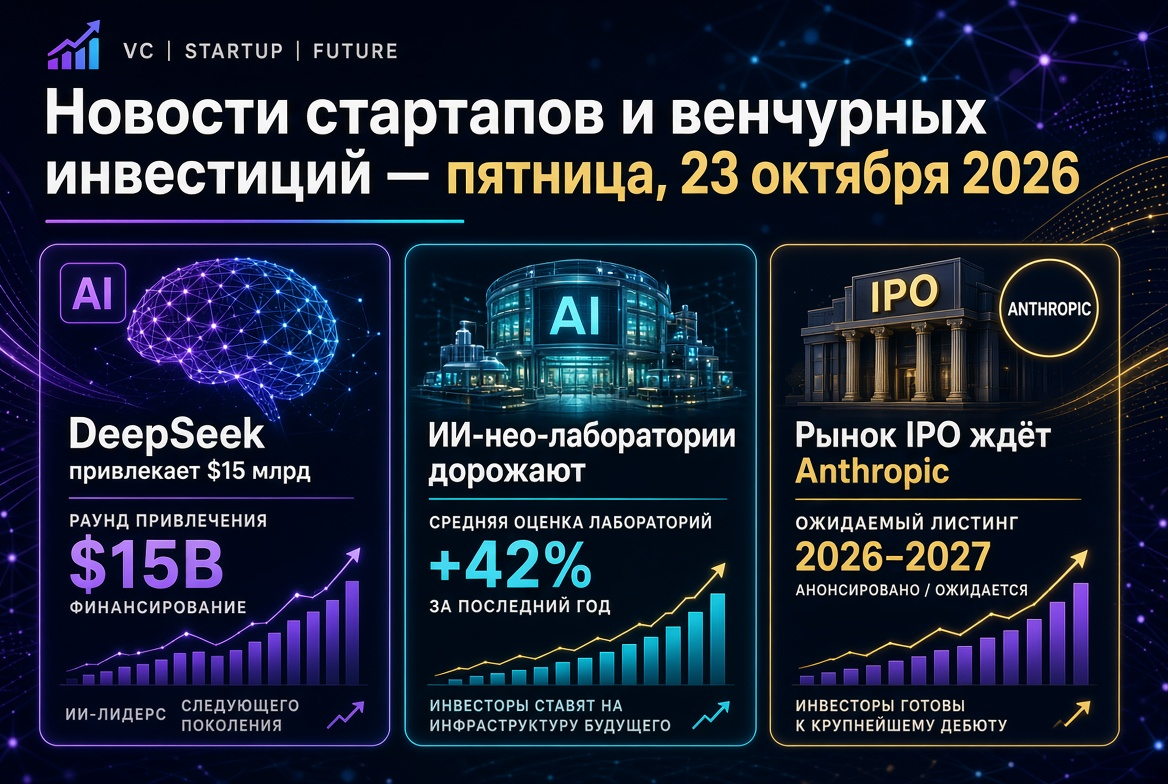
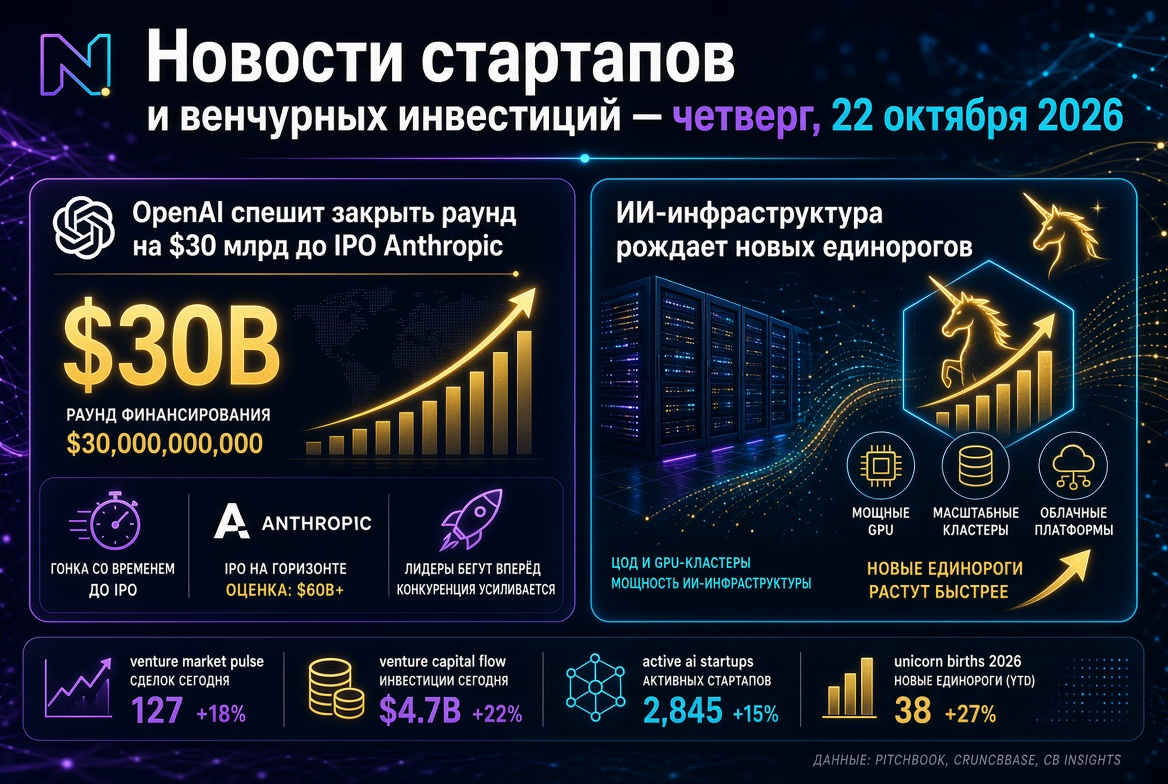
While in 2024-2025 investors actively funded applied AI companies, the weight is now shifting even more towards infrastructure. This encompasses computing, chips, models, energy, load management, and software architecture, without which scaling AI becomes prohibitively expensive and slow.
This is why the largest market deals increasingly revolve around segments that can be characterized as the "shovels and pickaxes" of the new technological cycle. Venture funds and strategic investors are more willing to finance startups that can become critical links in the AI supply chain than those with specialized applied functions. This raises interest in semiconductors, systems software, GPU clusters, data center optimization, and infrastructure for deploying models into commercial operation.
- The highest demand persists in AI infrastructure, semiconductors, compute orchestration, and enterprise AI stacks.
- Funds are increasingly preferring platform assets over point AI applications.
- Valuations in infrastructure segments are rising faster than in traditional SaaS.
Large Rounds Confirm: The Market is Again Paying a Premium for Core Technology
In recent days, several notable deals have bolstered market sentiment. One of the most illustrative events was a large funding round for SiFive — a developer of RISC-V-based architectures and solutions. The attraction of hundreds of millions of dollars with the participation of high-profile investors shows that capital is once again willing to pay a high price for assets at the intersection of AI, data centers, and chip design.
Simultaneously, there is an increasing influx of funds into next-generation AI companies in Asia. This is important not only as a news backdrop but also as a signal of geographical expansion in the venture cycle. If the global startup market was previously viewed predominantly as an American story, it is now clear that China and other Asian ecosystems are also scaling up their roles in the race for capital, talent, and computational resources.
For venture investors, this means that the startup and venture investment market is again valuing not only revenue growth but also the depth of the technological moat, control over intellectual property, and the company's ability to become a standard in its category.
A Record Q1 Does Not Indicate a Broad Recovery for the Entire Market
The initial data for the first quarter of 2026 looks impressive: the global volume of venture funding has sharply increased, and headline figures create a sense of a full market turnaround. However, it is vital for funds not to succumb to the illusion of broad normalization.
In practice, a two-speed market is forming. On one side, there is a small group of startups that are landing massive rounds and can choose their investors. On the other side, a broad layer of companies, especially those outside AI, still finds themselves agreeing to tougher terms, lower multiples, and longer fundraising processes.
- Late-stage investments are attracting significantly more capital than the broader early market.
- AI companies receive a premium in valuations even with comparable growth metrics.
- Non-AI segments more frequently face requirements for efficiency and reduced burn rates.
- Funds are becoming more selective in follow-on investments.
Hence, the current growth of the venture market cannot be interpreted as a return to an era of "money for everyone." It is growth in favor of the best assets, rather than the entire ecosystem.
Europe Gains Strength, But a Divide is Already Apparent Within the Region
The European venture market in 2026 appears more resilient than many expected. Interest remains in deeptech, AI, defense tech, climate tech, and enterprise software across the continent. An additional factor is the rise of venture debt, which is increasingly being used as a tool to extend runway without immediate dilution of shares.
However, within Europe, a more pronounced divide is forming. Companies working in AI and associated infrastructure continue to attract capital on favorable terms. Other startups must be more flexible: lowering valuation expectations, agreeing to tougher liquidation preferences, and demonstrating a stronger path to profitability.
For global funds, this creates an interesting opportunity. Europe remains a source of quality engineering teams and applied B2B startups, but the market demands significantly tighter selection. A simple bet on the region no longer works — a bet on the right vertical within the region is essential.
Fintech Returns, But Without Previous Euphoria
After a challenging period, fintech is again beginning to increase its capital raised. However, this growth is not due to a mass expansion in the number of deals but through larger checks in fewer companies. In other words, fintech is once again an attractive investment area, but the market is now much more mature and selective.
The most appealing segments are those intersecting fintech with AI, back-office process automation, risk management, B2B payments, and tax infrastructure. This is particularly important for funds targeting a global audience: such business models scale more easily internationally and better fit the requirements of corporate clients.
- Fintech is no longer pitched solely as a story of growing user bases.
- Investors demand clear product economics and sustainable monetization.
- The winners are not the loudest brands, but companies integrated into real financial processes.
China and Asia Strengthen Their Own Venture Circuit
One of the most pivotal topics in April is the strengthening of the Asian venture circuit. In China, government and quasi-government mechanisms for supporting tech companies have sharply intensified. This primarily concerns areas deemed strategic: AI, robotics, semiconductors, quantum tech, and industrial software.
Such a shift alters the global architecture of the startup and venture investment market. For international investors, this means Asian ecosystems will increasingly develop not as a peripheral growth market but as a standalone center for forming technological leaders. Consequently, competition for deeptech assets and AI companies will intensify not only among funds but also between geopolitical capital blocs.
This also raises the significance of due diligence regarding regulatory risks, export restrictions, and compatibility with international exit strategies.
The IPO Window is Slightly Open, But the Exit Market Remains Selective
One of the main hopes for the venture market in 2026 remains the recovery of exits. Currently, the picture is uneven. On one hand, investors are clearly ready to discuss large public offerings and are closely monitoring pre-IPO stories. On the other hand, the IPO window remains sensitive to interest rate volatility, geopolitics, and issuer quality.
This means that in the coming months, the public market will likely see primarily large, recognizable, and strategically significant companies coming to market. For most startups, the more realistic exit path continues to be through M&A. Therefore, the increase in corporate activity and large acquisitions is currently just as crucial as potential IPOs.
For venture funds, the takeaway is clear: exit planning must be constructed around several scenarios simultaneously. Relying on a single path through IPO in the current cycle appears too risky.
What This Means for Venture Investors and Funds Right Now
The current market favors those who can balance discipline and speed. There is more money in the system, but competition for the best assets has intensified. The most attractive startups are securing capital faster, while the average market continues to feel pressure.
Against this backdrop, the logic of fund operations is shifting:
- The focus is shifting towards AI infrastructure, deeptech, cyber, energy-for-compute, and B2B fintech.
- The significance of secondary deals and structured rounds continues to grow.
- The quality of the syndicate is becoming almost as important as the size of the check.
- The ability to evaluate exit optionality is turning into a key competitive advantage.
The main theme as of April 12, 2026, is not simply the growth of the startup and venture investment market. It marks a transition to a new phase where capital is active again, but operates in a much more rational manner. The winners will be startups with strong technology, sustainable product architecture, and a clear role in the new AI economy. Meanwhile, the winners among funds will be those who can differentiate temporary excitement from long-term platform value.