Startup and Venture Capital News for Thursday, February 5, 2026: Key Deals, Growth in AI and Deeptech Investments, Venture Fund Strategies, and Global Startup Market Trends.
As of early February 2026, the global venture capital market continues to show a steady recovery after the downturns of recent years. Early estimates suggest that 2025 was the third most successful year in history for startup investment volumes, second only to the peak years of 2021 and 2022, indicating a return of large private capital to the technology markets. Investors worldwide are once again actively funding promising companies, with record-scale deals being made, and startup plans for public offerings are back on the agenda. Major venture funds are launching new mega rounds and strategies, while governments and sovereign funds are increasing support for innovation, striving not to fall behind in the global technology race. As a result, the positive dynamics of the venture market instill cautious optimism for 2026, although investors remain selective regarding valuations and business models.
The Return of Mega Funds and Record Investments
After a period of quiet, "mega funds"—massive capital pools for technology investments—are back in the market. The American flagship Andreessen Horowitz (a16z) has raised over $15 billion in new funds, increasing its assets under management to a record $90 billion. These funds are directed towards priority areas such as artificial intelligence, cryptocurrencies, defense technologies, and biotech. Meanwhile, Japanese SoftBank has strengthened its presence in the AI sector: at the end of 2025, SoftBank invested $22.5 billion in OpenAI, making it one of the largest single investments in startup history. The resumption of activity from such players confirms the trend of capital concentration among industry leaders and the desire of investors to secure a stake in the next technological breakthrough.
AI Startup Boom: Unprecedented Funding Rounds
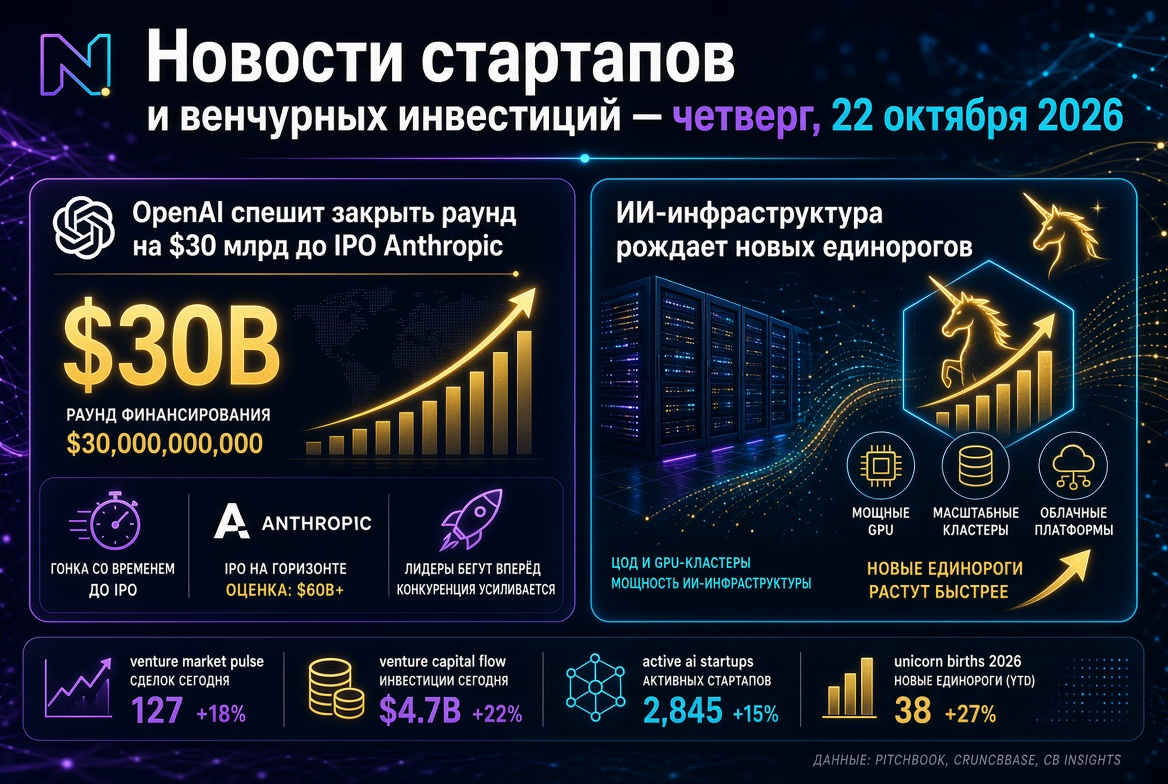
The artificial intelligence sector remains the primary driver of the venture boom. AI startups are attracting unprecedented investments, setting new records in funding round sizes. For example, xAI, founded by Elon Musk, secured approximately $20 billion in funding with participation from Nvidia—an extraordinary amount for a private company. OpenAI, a leader in the AI market, is not only attracting capital but also entering strategic partnerships: the company ensured exclusive supplies of high-performance Cerebras chips worth over $10 billion to accelerate its models, reinforcing its technological advantage. In addition to the giants, new players are rapidly emerging: in the U.S., generative video startups like Higgsfield and voice AI firms like Deepgram reached "unicorn" valuations just a few years after their founding. In Europe, the German company Parloa raised $350 million at a $3 billion valuation, highlighting the global nature of the AI frenzy. The massive funds directed into AI reflect the intense competition among companies and countries for leadership in this field, creating new market imbalances as the lion's share of venture dollars flows into AI projects.
Major Exits in Fintech and a Wave of Mergers
The financial technology sector is witnessing a wave of consolidation, signaling a maturation of the fintech market. Several high-profile deals were announced in January 2026. Capital One bank agreed to acquire the startup Brex— a platform for managing corporate expenses—for $5.15 billion. This purchase became the largest "bank-fintech" deal in history, emphasizing the desire of traditional financial giants to integrate cutting-edge fintech solutions. The European venture fund Hg acquired the American financial platform OneStream for approximately $6.4 billion, buying out shares from investors, including KKR. Other deals include Deutsche Börse's purchase of the Allfunds platform for €5.3 billion to bolster its position in WealthTech, while US Bancorp acquires the brokerage firm BTIG for up to $1 billion. In addition to large acquisitions, several fintech startups have also entered the acquisition market: for instance, the Australian unicorn Airwallex is expanding in Asia by acquiring the Korean payment company Paynuri. The uptick in M&A transactions illustrates that as the industry matures, successful fintechs either fall under the wing of larger players or grow through strategic acquisitions.
Revival of IPOs: Startups Return to the Market
The initial public offering (IPO) market for technology companies is reviving after a prolonged pause. The year 2025 surprised analysts with the number of significant IPOs: in the U.S. alone, at least 23 companies went public with valuations exceeding $1 billion (compared to 9 a year earlier), and the total capitalization of these offerings surpassed $125 billion. Investors are once again ready to welcome profitable and rapidly growing companies to public markets, especially if the business has a strongly defined story around AI or other "hot" technologies. In 2026, this trend is expected to continue, with several "unicorns" hinting at preparations for an IPO. Among the most anticipated IPO candidates are:
- The largest fintech "unicorns": payment platforms Plaid and Revolut;
- Leaders in the field of artificial intelligence: AI model developer OpenAI, big data platform Databricks, business AI startup Cohere;
- Other tech giants: for example, space company SpaceX, if market conditions are favorable.
Successful debuts for these companies could provide an additional boost to the market, although experts warn that market volatility could suddenly close the "IPO window." Nevertheless, the revival of public offerings strengthens the belief that investors are ready to reward startups with strong growth and profitability metrics.
Defense and Cybersecurity Startups in the Spotlight
The geopolitical climate and new risks are reshaping the priorities of venture investors. Amid tensions between powers and the drive for technological independence, significant capital is being directed into defense and cybersecurity startups. In the U.S., the "American Dynamism" initiative is gaining momentum—investments in technologies that bolster national security. An example is the aforementioned mega round from a16z, part of which will go to startups in defense and deeptech. Startups developing solutions for military and government entities are attracting nine-figure sums: California-based Onebrief, which creates software for military planning, recently secured around $200 million in investments at a valuation exceeding $2 billion and acquired a profile startup to expand its platform's capabilities. In Europe, the rapidly growing cybersecurity startup Aikido Security from Belgium achieved "unicorn" status ($1 billion) just two years after its inception, offering a comprehensive code and cloud protection platform. Such successes reflect the growing demand for technologies that ensure digital and national security—from supply chain protection (as demonstrated by the British company Cyb3r Operations, which raised $5 million to monitor cyber risks) to new intelligence and satellite observation tools. The trend towards increased support for defense projects is also noticeable at the government level: governments and funds, particularly in the U.S., Europe, and Israel, are keenly investing in startups that can provide a strategic advantage.
Regional Highlights: the U.S. Leads, Europe and Asia Catch Up
In geographical terms, the venture boom is global, although it is unevenly distributed. The U.S. remains the main engine, accounting for the lion's share of large rounds, particularly in the AI sector. Silicon Valley maintains its status as the main center for capital attraction, although competition for talent and deals is growing worldwide. Europe is undergoing a landscape restructuring: continental economies are ramping up venture investments. Germany outpaced the UK in startup investment volumes in 2025, indicating the strengthening of European hubs. Regional EU funds and government programmes (such as initiatives from France and Scandinavian countries) are stimulating the creation of local unicorns and the development of the artificial intelligence sector. In Asia, the dynamics are mixed: the Indian ecosystem has reached a new level of maturity—with the first "unicorns" of 2026 emerging in January and high-profile IPOs recommencing on local exchanges, reflecting the scale and maturity of the market. In contrast, the Chinese venture market remains relatively restrained due to regulatory pressure and capital reorientation towards domestic priorities; however, Chinese investors are actively investing in foreign AI and chip projects to stay in the game. The Middle East and North Africa are showing acceleration: funds from the UAE, Saudi Arabia, and Qatar are increasing funding for tech companies both in their regions and globally, supporting fintech, cloud services, and AI startups. Startup activity is also growing in Latin America and Africa, although in absolute numbers, these regions still lag behind the rest of the world. Thus, the venture rise is indeed encompassing all continents, forming a more balanced global innovation ecosystem.
Looking Ahead: Cautious Optimism and New Guidelines
Despite the current upswing, investors retain a degree of caution, remembering the lessons from the recent market "cooling." Capital is flowing back into the tech sector, but requirements for startups have become stricter: funds expect clear business models, economic efficiency, and clear pathways to profitability from the teams. Company valuations are rising, especially in the AI segment; however, investors are increasingly focusing on risk diversification and long-term portfolio sustainability. The returning liquidity—from billion-dollar funds to new IPOs—creates opportunities for substantial growth, but also heightens competition for standout projects. It is likely that the venture capital sector will enter a phase of more balanced development in 2026: funding for "breakthrough" areas (AI, biotech, climate technologies, defense) will continue, but there will be increased attention to the quality of growth, corporate governance, and compliance with regulatory requirements. This approach should help the market avoid overheating and lay the foundation for sustainable innovation development in the long term.