Startup and Venture Capital News — Thursday, March 19, 2026: AI Mega Rounds, New Wave of Robotics, and the Return of the Exit Window
As of March 19, 2026, the global startup and venture capital market remains in a phase of active capital restructuring. The main focal point continues to be within the artificial intelligence segment; however, the market structure is noticeably broadening: investors are increasingly turning their attention to robotics, fintech, cybersecurity, digital healthcare, and climate tech. For venture funds, this signifies that the market is no longer solely driven by the theme of generative AI — capital is now seeking more practical and infrastructure-oriented narratives with clear monetization paths, industry specialization, and shorter commercialization horizons.
Amidst this backdrop, competition intensifies for quality deals at late and growth stages, with the ecosystem increasingly forming around two contours. The first comprises AI platform companies aiming for dominance in the enterprise segment. The second involves industry-specific startups that utilize AI as a production layer within their products: in robotics, medicine, finance, security, energy, and infrastructure. This configuration is currently the most crucial for global venture investors, family offices, and growth funds.
AI Remains the Primary Magnet for Capital, Yet the Market Becomes More Selective
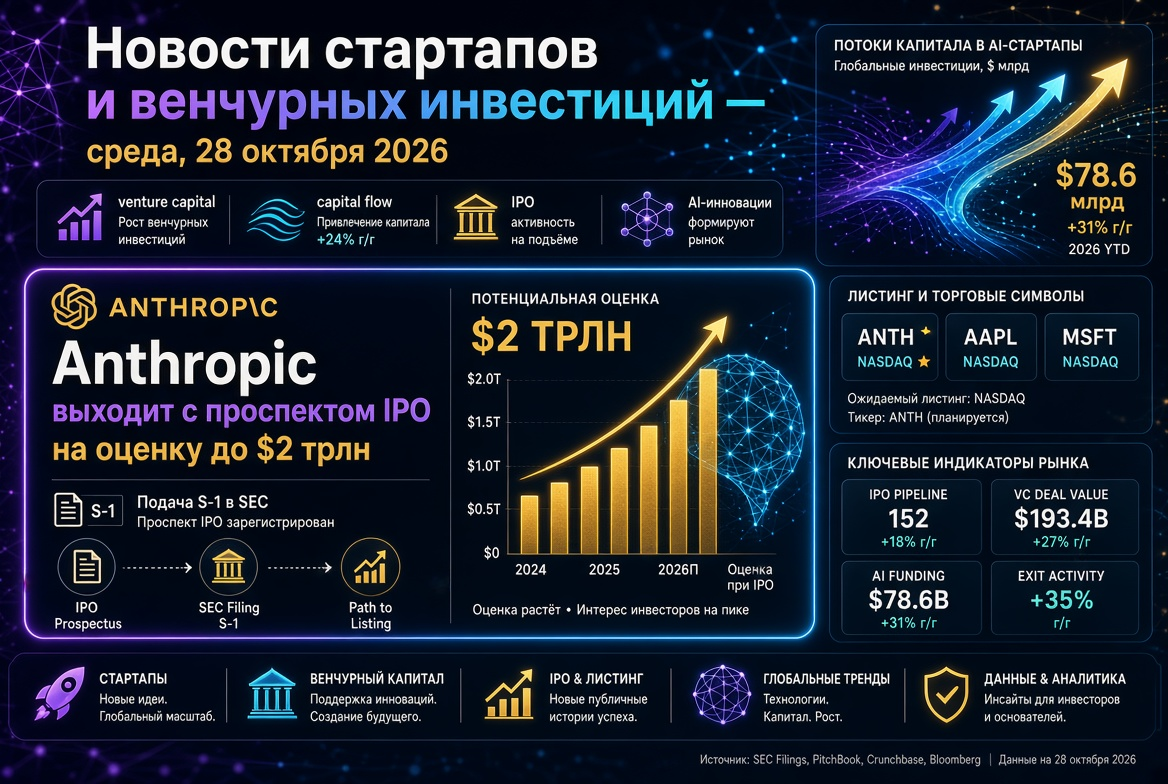
The most notable trend in March is the concentration of large rounds around top-tier AI teams and companies that can prove technological superiority rather than merely existing in a fashionable category. Investors continue to fund large-scale ventures in models, infrastructure, and agentic AI, but the quality requirements regarding the team, pace of commercialization, and product defensibility have significantly increased.
For the venture market, this indicates a shift from a phase of "buying any AI exposure" to a phase of selecting platform winners. High valuations persist, but increasing amounts of capital are flowing to startups that are not just building interfaces over existing models, but rather complete technological stacks, unique datasets, computational infrastructures, or vertical solutions for enterprise clients.
Mega Rounds Again Set the Agenda and Establish Valuation Benchmarks
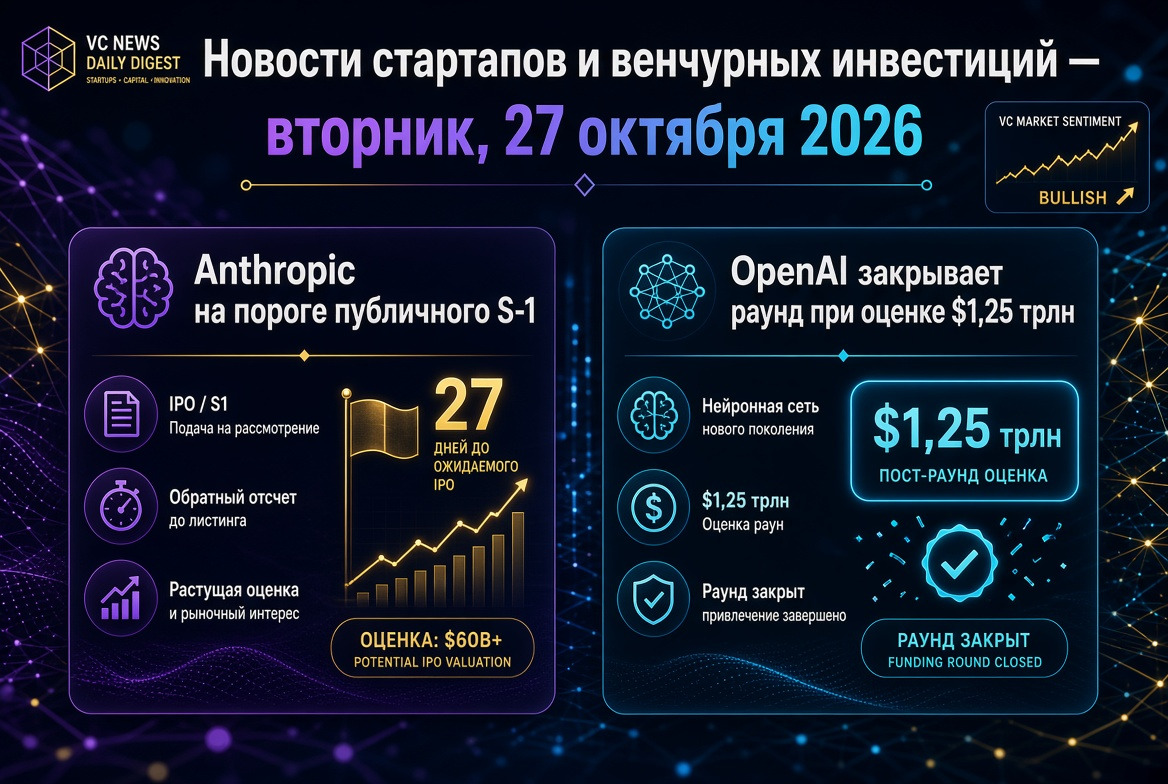
This week, the startup and venture capital market is actively discussing a new wave of large rounds. This trend is particularly prominent in AI and robotics, where investors are willing to pay not only for growth but also for an option on technological leadership. Rounds of this scale are important not just in themselves; they effectively become benchmarks for the entire market concerning multiples, expectations, and the structure of subsequent deals.
- Large AI companies continue to attract capital in amounts that were recently characteristic of pre-IPO stages.
- Robotics startups are receiving increased attention from growth funds as the market bets on physical AI and the automation of the real economy.
- Infrastructure solutions for enterprise and data-heavy industries are becoming a priority for institutional investors.
Practically, this reinforces the divide between leaders and all other players. The top startups secure capital more quickly and on better terms, while the average segment of the market remains demanding and, at times, closed off.
Robotics Steps into the Limelight, Becoming a New Layer of Venture Growth
If from 2024 to 2025 attention was primarily focused on foundation models and copilot products, by 2026, increasing capital is being directed towards robotics and embodied AI. This is not an incidental spike, but a logical extension of the AI cycle: following the era of software agents, the market is now actively financing systems capable of transferring intelligence to physical processes — from industry and logistics to transport, warehousing, and specialized services.
Importantly, investors today are betting not only on humanoid projects but also on specialized robotics. This approach appears more mature for venture investments: it demonstrates clearer unit economics, better-defined verticals for implementation, and a higher likelihood of early corporate contracts.
- The emphasis is shifting from general hype to practical performance.
- Funds are seeking startups that address specific operational challenges rather than those developing a "universal robot for everything."
- Teams with a strong engineering foundation and access to industrial data find themselves in a favorable position.
Enterprise AI Becomes the New Intersection for Venture Capital and Private Equity
Another significant shift is the convergence between the worlds of venture capital and private equity. Major AI platforms are increasingly viewed not just as funding targets but also as tools for transforming portfolio companies. This changes the market dynamics: AI is evolving from being solely a venture narrative to becoming an infrastructure for efficiency enhancement for large industrial and service assets.
For funds, this is particularly relevant for two reasons. Firstly, there is a growing demand for B2B startups that can rapidly integrate into corporate structures. Secondly, there is heightened interest in companies that offer not just products, but measurable economic impacts — cost reduction, process automation, revenue growth, or reduced operational risks.
Fintech Solidifies Its Position, While the Exit Market Signals Renewed Confidence
The fintech sector continues to show positive momentum. It no longer appears to be the primary recipient of venture capital as it did a few years ago, but it is returning to the agenda as a mature category with clear monetization strategies and strong scaling potential. This is particularly evident in Europe and Asia, where payment platforms, embedded finance, and digital banking services are once again drawing the interest of major investors.
Simultaneously, the exit window is slowly reopening. While public offerings and exit deals have yet to become commonplace, the mere fact of successful market tests is significant for the global venture market. For funds, this means not only potential liquidity but also a restoration of confidence in growth narratives that were under considerable pressure in 2023 and 2024.
Europe Aims to Bridge the Structural Gap in the Startup Ecosystem
For the global audience of investors, the European narrative is also crucial. Regulators and market participants are increasingly working to make the continent more competitive for launching and scaling technology companies. This pertains to business registration procedures, access to capital, and the formation of a unified space for the growth of innovative companies.
It is worth noting that in 2026, Europe is attempting to bolster its position not only through regulation but also through concrete investment signals. For venture funds, this translates into a growing number of quality deals in the region, particularly in AI infrastructure, fintech, chip design, climate software, and industrial technology. While Europe has yet to catch up to the U.S. in terms of the depth of late-stage funding, it is no longer solely perceived as an early-stage market.
Cybersecurity, Healthtech, and Climate Tech Establish Themselves as Strategic Verticals
Beyond artificial intelligence, there is an increasing focus on verticals where technological effects can rapidly translate into economic results. Primarily, this includes cybersecurity, digital health, and climate technologies. For investors, these segments are especially appealing because demand in them is supported not only by innovative trends but also by fundamental necessities.
Why These Segments are Now in the Spotlight
- Cybersecurity: corporate clients are willing to pay for risk mitigation today, rather than in the distant future.
- Healthtech: AI is beginning to operate in the real healthcare domain, where time and quality savings are quickly monetized.
- Climate Tech: despite the challenges at the growth stage, the demand for energy and infrastructure solutions remains strong.
In these verticals, many funds are currently searching for more rational entry points: lower risk of speculative overheating and a higher likelihood of sustained demand from corporations and the government.
The Main Market Risk: Not a Lack of Capital, but Its Over-Concentration
Despite the positive news background, the startup and venture capital market remains uneven. There is plenty of money in the system, but it is distributed very selectively. The strongest startups in AI, fintech, robotics, and cybersecurity are receiving large checks swiftly, while many companies in software and traditional SaaS still face stricter funding conditions, reevaluation of growth strategies, and pressure on their debt levels.
For investors, this indicates that 2026 should not be viewed as an unconditional return to a "broad bull market" in venture capital. Rather, it pertains to a market of targeted aggression: capital is flowing to leaders, infrastructure assets, and companies with proven economics. The rest must undergo renewed scrutiny regarding efficiency, profitability, and genuine technological differentiation.
What This Means for Funds and Venture Investors Right Now
As of March 19, 2026, the optimal strategy for professional market participants appears as follows:
- Look beyond generative AI and seek applied industry solutions.
- Prioritize teams that possess not only strong technology but also a genuine channel for corporate distribution.
- Evaluate not just revenue growth, but the quality of revenue mix, customer retention, and the pathway to operational efficiency.
- Monitor regions where regulatory environments are improving and support for innovative companies is increasing.
The summary of the current week for the startup and venture capital market indicates that AI continues to set the pace, robotics is emerging as the next major investment layer, fintech and healthtech are regaining institutional interest, and Europe is striving to establish a more competitive infrastructure for startups. For global funds, this is not merely a stream of news but a signal that the market is once again prepared to pay a premium for technological leadership — but only where it is backed by commercial reality.