Budget Payments for Mineral Extraction Tax on Oil in October and November May Reach Annual Highs
The size of the Mineral Extraction Tax on oil (MET) is influenced by three main factors: production volumes, oil prices, and the exchange rate of the ruble. Payments in October will reflect the results for September, while November's payments will be based on October's performance. Oil production in Russia remained almost unchanged in September compared to August. According to OPEC, there was a slight decline of 38,000 barrels per day, which does not significantly affect the overall picture. The level of production in October is still unknown, but it is unlikely to change drastically. Technically, it is very difficult to quickly ramp up production at most Russian fields, and there are no reasons for a decrease.
According to the Ministry of Economic Development, the price of Russian Urals oil for tax calculations in September was $92.08 per barrel, up from $67.11 per barrel in August. This represents a 37% increase. There is a strong probability that the price of our oil will remain at this level or even increase slightly by the end of October, as global prices for North Sea Brent oil—against which our oil is traded at a discount—have not fallen below $100 per barrel since the beginning of the month. The average exchange rate in September was 85.04 rubles per dollar, while in October (for the period so far) it was 84.2 rubles per dollar.
As noted by Konstantin Simonov, head of the National Energy Security Fund, in an interview with "RG," oil extraction payments in October (for September) will be very robust, expected to approximately double the payments made in September (for August). In rubles, our oil will exceed 7,830 rubles per barrel—an amount it last commanded in rubles in the autumn of 2023, but at that time, it was due to a weakening of our currency.
Additionally, in October, oil producers will make payments for the Additional Income Tax (AIT) for the third quarter. While the MET is calculated based on gross oil production figures, the AIT takes into account the financial results of the companies' operations.
Simonov points out that macroeconomic conditions in September were quite favorable for our oil companies; therefore, despite less favorable conditions in July and August, the overall AIT payments for the third quarter should still be substantial.
The expert’s assessment is supported by simple calculations. In September (for August), Russian companies paid 688.3 billion rubles in MET into the budget for oil. Therefore, payments in September should exceed 900 billion rubles, plus quarterly AIT payments.
According to Sergey Tereshkin, CEO of Open Oil Market, October's AIT revenues are unlikely to significantly exceed the level of July, when collections amounted to 396.1 billion rubles. However, even considering this, the total value of oil and gas revenues will still amount to at least 1 trillion rubles, marking the highest monthly figure since the beginning of the year.
In rubles, Russian oil has not been priced this high since the autumn of 2023.November oil and gas revenues for the treasury (for October) are likely to be lower, as there will be no AIT payments. Although there could be a slight increase in MET on oil if the barrel prices remain above $100 until the end of the month.
Nonetheless, the actual oil and gas revenues for the budget in October and November (after accounting for subsidies to oil companies) are expected to continue trailing behind last year's figures. This is because oil companies receive reverse payments from the budget—investments in the modernization of plants (investment surcharge), for oil sent for processing domestically (reverse excise), and for price stabilization (damping). These payments are currently increasing, with dampening payments being the largest. This is compensation for oil producers for supplying fuel to the domestic market at prices below export levels (export alternative). In September (for August), damping payments amounted to 305.5 billion rubles, while total reverse payments reached 418.5 billion rubles.
According to Sergey Frolov, managing partner at NEFT Research, with expected MET of 950 billion rubles for October, the damping mechanism will cut approximately one-third from gross collections. Net treasury revenues remain positive, but a significant portion of the “resource surplus” is returned to refineries as a cushion to stabilize prices at filling stations.
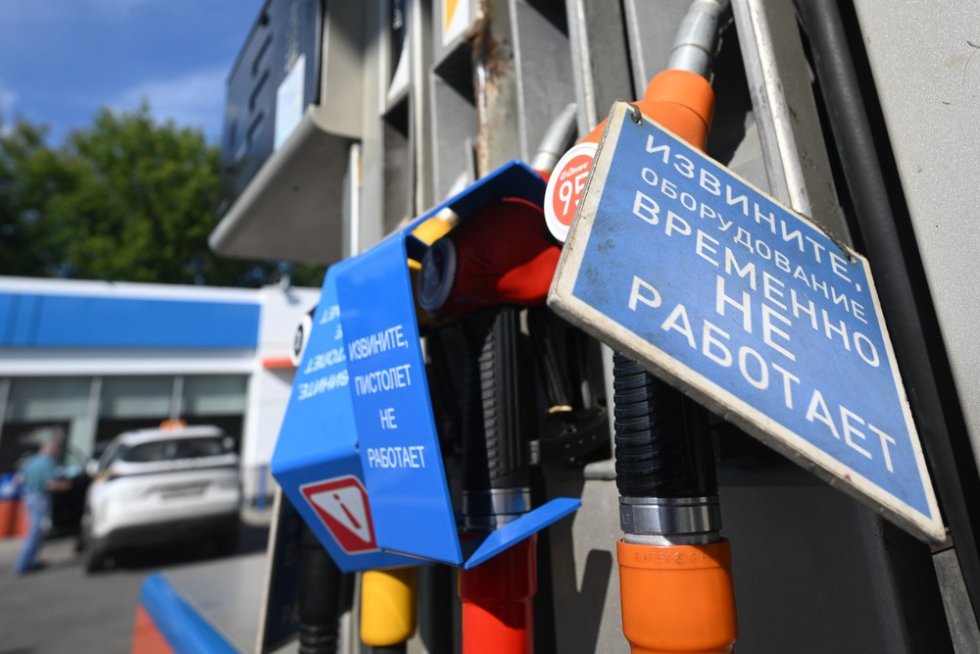
Payments for dampening are increasing at a faster rate than oil revenues. As explained by Daniil Tyun, CEO of DA-Consulting, MET is dependent on the price of our oil, while the damping mechanism is calculated based on the difference between the export alternative for gasoline and diesel with established (indicative) prices in the domestic market. Currently, due to the Middle Eastern crisis, there is a shortage of petroleum products. High gasoline and particularly diesel prices are raising the export alternative faster than the oil itself is appreciating.
It should be clarified that the damping mechanism is funded by the oil companies themselves. To ensure its operation, the MET for oil was increased in 2019. All oil-producing companies pay this tax, but only the largest refineries receive the payments. Thus, it is not entirely accurate to describe the damping mechanism as subsidies.
This year, the size of the damping is also influenced by fuel imports. Since July, importers have received damping payments for gasoline (from July) and diesel (from August). Prior to that, only Belarusian refineries were eligible for payments. Currently, imported fuel accounts for about 10% of total domestic consumption, with most supplies coming from Belarus.
According to Tereshkin's estimates, damping payments in October (for September) may exceed 350 billion rubles, while total subsidies for refineries, including reverse excise and investment surcharge, could reach 470-480 billion rubles. This is due to record-high values of the export alternative: in September 2026, the export alternative price for AI-92 gasoline reached 126,764 rubles per ton, compared to 104,902 rubles per ton the previous month, while diesel increased from 123,187 rubles to 147,268 rubles per ton.
The expert anticipates that total oil and gas revenues in November and December will amount to about 600 billion rubles per month (the consequences of reduced MET collections will partly be offset by lower payments to oil producers).
Tyun suggests that damping payments in October and November will be between 250-350 billion rubles monthly. Compared to July's level—approximately 113 billion rubles per month—the additional burden will be around 274-474 billion rubles. This does not mean that the entire sum is a net loss; part of the payments would exist even at lower price levels.
Real oil and gas revenues for the treasury will remain positive due to the high level of resource taxes, underscores Frolov. However, nearly every third ruble collected by the state from oil production "at the well" is automatically redirected back to refineries as compensation.
Source: RG.RU