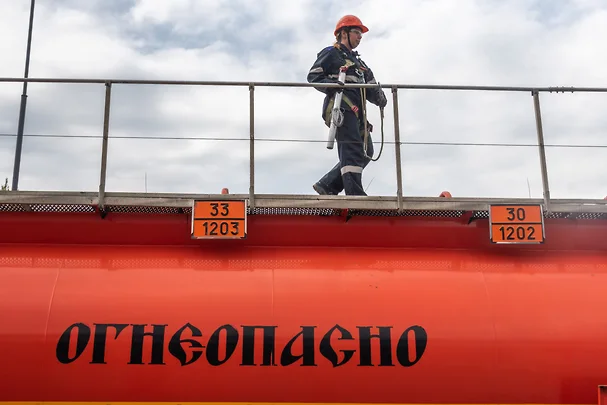
According to the People's Farmer association, fuel for farmers has risen in price by approximately 35% over the past two months. Stanislav Sankeev, executive director of the association, told Russian Gazette that a difficult fuel situation is now observed across the country.
"For example, in the Volga and Central Federal Districts, our colleagues say prices start at 87 RUB per litre, but diesel is not available immediately – the waiting period is from four days," he says.
Specifically, in Mari El, diesel is now sold from 88 RUB per litre, in Ulyanovsk and Samara regions – 89 RUB per litre, and in Belgorod and Bryansk regions – around 90 RUB per litre.
For enterprises operating under high debt burdens and rising production costs, even such an increase becomes a sensitive factor.
Over the past two months, fuel for farmers has risen in price by about a third. However, diesel is not always available immediatelySmall farms are particularly sensitive to the price increase. Large agriholdings often have the ability to enter into long-term contracts, build up fuel reserves in advance, or secure more favourable purchasing terms. For farmers and medium-sized agricultural enterprises, the room for manoeuvre is significantly limited.
Moreover, the impact of rising fuel costs is not limited to additional expenses for field work. Diesel remains a key component of transport costs, so price increases also affect agricultural logistics. The higher the cost of transporting raw materials and finished products, the greater the pressure on the entire production chain.
However, industry representatives are not yet inclined to dramatise the situation. Alexey Krasilnikov, executive director of the Potato Union, acknowledges the existence of fuel supply problems in certain regions but considers them solvable. When difficulties with availability arise in one region, fuel is promptly delivered from neighbouring areas. According to Krasilnikov, transport costs account for only about 5% of the cost structure, so even a noticeable increase in fuel prices does not necessarily lead to a significant rise in the prices of vegetables and potatoes on the store shelf. The current situation has a much more serious impact directly on producers.
Looking at price movements on the exchange, in the European part of Russia, quotations for diesel fuel (DT) – the main type of fuel used for agricultural work – have risen by 19% since the beginning of March, and by 17% in over-the-counter deals. But this is an average figure; the European part of Russia is large, and agricultural enterprises, especially small and medium-sized ones, typically buy fuel at local oil depots rather than from large traders.
As noted by Yuri Stankevich, Deputy Chairman of the State Duma Committee on Energy, in an interview with RG, wholesale price increases may be higher than the dynamics of exchange indices. Not all fuel volumes are sold via the exchange – a significant portion is sold through off-exchange contracts, and the price for the end farmer includes logistics, storage, and traders' credit costs. In anticipation of further price increases and reduced fuel supply, market participants may factor in a "risk premium".
Spring field work traditionally creates a peak in diesel consumption. But overall there is no fuel shortage in the country, experts are confidentThe issue of price increases in the small wholesale market segment, which is not included in the statistics of the St. Petersburg Exchange, was already raised by the industry community during the petrol price rise last autumn. Moreover, it is deeply concerning that compared to May last year, the volume of diesel sales on the exchange fell sharply – by 80% (from 1.1 million to 0.61 million tonnes). This is despite the fact that there was one more day of fuel trading on the exchange in May this year.
According to Stankevich, the rise in wholesale fuel prices for farmers and local shortages are the result of a combination of several factors. In the first place, seasonal demand and logistics play a role. Spring field work traditionally creates a peak in diesel consumption. In the southern regions, the infrastructure burden is higher than the national average: demand is concentrated in a short period, and logistical capabilities (railways, oil depots, vehicle fleets) are limited. Even with sufficient overall production volumes, local "bottlenecks" arise, leading to temporary shortages. Today, the situation is aggravated by continuous attacks on oil refineries and storage infrastructure (oil depots and fuel storage facilities).
According to Rosstat, in April of this year, the production of coke and petroleum products in the country decreased by 9.2% year-on-year, and by 11.3% compared to March. Statistics on fuel output by type are not available, and consolidated data for May have not yet been published. Energy expert Kirill Rodionov believes that the April decline was a continuation of the trend from the first quarter of 2026, when the volume of primary oil refining in the country fell by 1.6% year-on-year (to 64.1 million tonnes), and the output of petrol and diesel decreased by 4.8% (to 10.8 million tonnes) and 0.6% (to 21.4 million tonnes) respectively.
But overall, there is no fuel shortage in the country, experts are confident. It is a matter of supply disruptions in some regions. As Sergey Frolov, managing partner of NEFT Research, notes, local shortages and price increases are linked to a physical shortage of fuel in the southern regions caused by attacks on refineries, as well as disrupted logistics as a result. It is possible to buy the required volume of fuel, but the problem is how to deliver it intact to its destination.
Sergey Tereshkin, CEO of Open Oil Market, holds a similar view: unscheduled repairs at refineries are to blame, causing a rush in the market. As soon as the situation with refinery utilisation becomes clear, prices will likely begin to decline.
But of course, one should not blame everything on the difficult fuel market situation. According to Dmitry Gusev, Deputy Chairman of the Supervisory Board of the "Reliable Partner" association and a member of the expert council of the "Russian Petrol Stations" competition, it is surprising that agricultural producers continue to complain about rising fuel prices every spring. The dynamics of fuel prices throughout the year are well known to everyone, especially to those whose business success depends on it. One could purchase fuel in advance, when prices are not breaking records. To hedge risks – arrange with a specialised agricultural bank to finance the purchase of fuel during the low season, in winter.
One could argue that only large agricultural enterprises can afford to purchase fuel in advance. Medium-sized companies and small farmers hardly have the technical and financial capabilities to stock up in advance. As for loans, even on concessional terms for large companies, a loan for fuel purchases would be a serious financial burden. On the other hand, after nearly 40 years of the private agricultural sector, its participants could have learned to prepare for the annual spring surge in diesel prices.
The Ministry of Energy declined to comment on RG's request. The Ministry of Agriculture did not provide comments at the time of publication.
Source: RG.RU