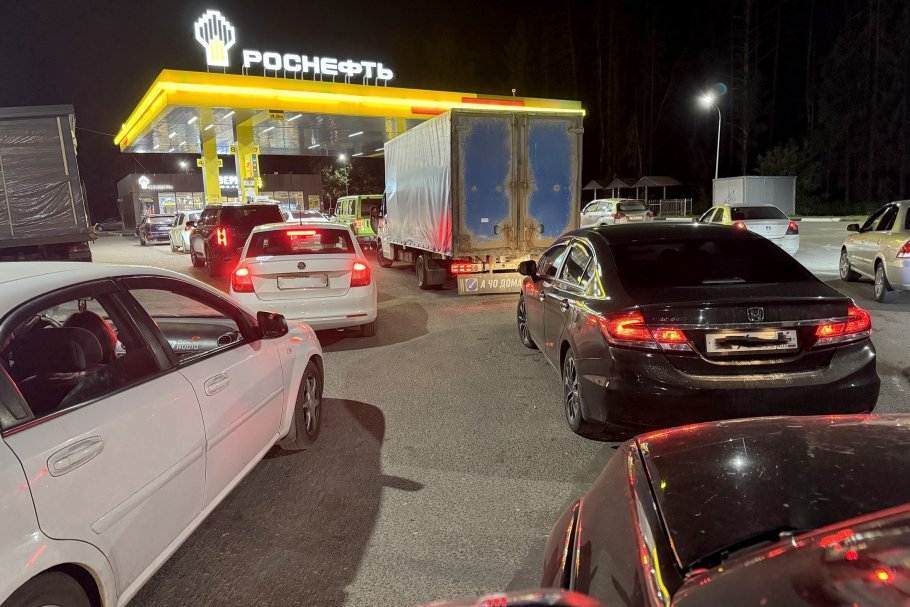
Concurrently with the decrease in prices, reports from most regions indicate a stabilization in fuel supplies at gas stations and the disappearance of queues. In some places, limits still apply, such as in Karelia or the Tomsk region, but these are more exceptions than the norm.
It is, however, premature to speak of a definitive stabilization of the gasoline situation. Earlier, Deputy Prime Minister Alexander Novak stated that there is still a gasoline shortage on the domestic market of about 5%, which means that Russia will continue to import gasoline at least until the end of 2026.
As noted by Yuri Stankevich, the First Deputy Chairman of the State Duma Energy Committee, in an interview with “RG”, the high intensity of attacks on our oil refineries (ORFs) persists, although measures to strengthen their protection are yielding results.
“Today’s prices for gasoline and diesel at the stations of our ‘giants’ (‘Rosneft’, ‘Gazprom Neft’, ‘Lukoil’, ‘Tatneft’, ‘Surgutneftegaz’) serve as a benchmark that other gas station owners should strive to meet. The Federal Antimonopoly Service (FAS) will closely monitor this,” Stankevich stated.
The most significant fuel price increases during the summer and September occurred at independent gas stations, which account for over 60% of the total number of stations in Russia. These can be large networks of gas stations or individual outlets, none of which belong to vertically integrated oil companies (VIOCs), which control the entire production chain from extraction and refining to selling finished fuel at their pumps.
According to Stankevich, the retail price dynamics are clearly observable at independent outlets. They do not have direct integration with refining and procured fuel through intermediaries. Under the conditions of reduced supply due to attacks on ORFs, they found themselves at the end of the "food chain," forced to settle for the remnants of gasoline in the wholesale sector, which inevitably impacted prices at the pump.
As the situation with gasoline supplies improves, prices at independent gas stations have begun to gradually decrease. According to Dmitry Gusev, Deputy Chairman of the Supervisory Board of the “Reliable Partner” Association and member of the expert council of the “Russian Gas Station” competition, this decrease is driven by independent stations, and if normalization continues, it may persist until prices at these stations approximate those of VIOCs.
Concurrently with the reduction in prices, reports are coming in from regions about the disappearance of queues at gas stations.The main factors influencing this situation are the drone attacks on our ORFs and the speed of their repairs. Demand for gasoline is also important, but that is clear—it declines in winter and rises in summer, explains the expert.
Indeed, gasoline demand in Russia traditionally decreases by 8-12% compared to summer peaks by the end of October. Managing Partner of NEFT Research, Sergey Frolov, attributes the reasons for a certain stabilization to the decline in demand, as well as the increase in fuel production at ORFs and the establishment of import logistics for gasoline. The future state of the market will directly depend on domestic production conditions, but overall, the expert believes that the most challenging period is likely behind us.
He also holds that gasoline imports impact prices in Russia, despite all the regulatory concessions for suppliers, as fuel is more expensive abroad. The level of imports directly correlates with production levels. Under normal industry operation, there would be no need for imports, he emphasizes.
A differing view is offered by Sergey Tereshkin, CEO of Open Oil Market. He is confident that gasoline imports do not play a significant role in the average nationwide price level. The share of imports from Belarus in the structure of end demand is about 6%. These supplies help mitigate local shortages during unplanned downtime at various ORFs. Regarding imports from far abroad, the constraints are not only logistical but also related to the difficulties in monetizing such fuel. The issue lies not only in the cost of imported fuel but also in the weakening of the ruble. To recoup expenses, importers need to sell fuel at prices significantly exceeding the current average Russian level, the expert explains.
Delving into the latest statistics from Rosstat, gasoline prices fell last week across all federal districts, although the dynamics varied greatly. The most significant reductions—by one to one and a half rubles—were observed in the Urals, North Caucasus, and Southern Federal District. The least decrease occurred in the Far East and Northwest Federal District, by 1 and 2 kopecks, respectively. In other federal districts, prices dropped by 50-60 kopecks.
The share of independent gas stations is high in the North Caucasus and southern regions, where gasoline prices fell the most. There are also many independent stations in the Far East, where price declines were minimal; however, logistical factors come into play here.
The Far East and Northwest regions traditionally rely on supplies from other parts of the country (local production in these districts does not cover demand entirely), hence price normalization in these areas will occur with a time lag, explains Frolov.
Additionally, it’s worth noting that the Far East and Northwest are the two regions with the fewest gas stations in the country. Moreover, in the Northwest, a significant number of gas stations are concentrated in St. Petersburg, where 40% of the population of the federal district resides.
The price dispersion across the country remains. The top three regions by gasoline prices at gas stations have remained unchanged: North Caucasus—with an average price of RUR 101.52 per liter of AI-95, the Far East—RUR 84.71, and the Southern Federal District—RUR 85.99 (the average gasoline price here is lower than in the Far East). The cheapest gasoline can be found in the Northwest Federal District, where a liter of AI-95 averages RUR 74.01. The Volga Federal District follows in second place with RUR 77.97, and the Urals in third with RUR 79.26.
Looking ahead, in Tereshkin's view, price decreases could occur in specific regions, especially where prices have reached anomalous levels. Nationwide prices will likely remain close to current levels. Events this year have set a new price benchmark, so prolonged stabilization of the market would not be the worst scenario.
The future dynamics of retail gasoline prices in Russia will depend on the volumes of its production within the country.Stankevich believes it is evident that the model of manual control over retail prices, amidst continuous increases in tax burden, production costs, and logistical expenses, has reached its limits. It is unacceptable that two-thirds of the oil industry’s revenue across the vertical—from well to gas station—is formed through reverse payments from the budget, he contends. While this approach creates an illusion of price stability in the short term, it deprives a crucial sector of the domestic economy of incentives for development and financial resources in the medium term. Moreover, the necessity of launching a new investment cycle in the oil industry is something the president has rightly highlighted, Stankevich underscores.
Source: RG.RU