Startup News, Venture Investments, Investment Deals, Global Venture Market, AI Startups, Startup Funding, Megarounds
By mid-November 2025, the global venture capital market is showing a confident upward trend after several years of decline. Investors around the world are actively financing technology startups once again: record-breaking deals are being made, companies are revisiting IPO plans, and the largest funds are triumphantly returning to the market with significant investments.
Global Upturn in the Venture Market
Recent data confirms the revival: in the third quarter of 2025, the global volume of venture investments reached approximately $97 billion, which is about 38% higher than a year ago and slightly above the previous quarter's results. This is the best quarterly figure since 2021 and marks the fourth consecutive quarter where total investments exceeded the $90 billion mark. After the "venture winter" of 2022-2023, startup funding has steadily grown for four reporting periods in a row, reflecting a return of investor confidence. The primary driver of growth has been the megarounds in the artificial intelligence (AI) sector, though the upswing is observed across all stages: particularly rapid increases have been seen in late-stage startup investments. About two-thirds of all venture investments in the last quarter flowed to companies based in the United States, but activity is also visible in Europe, Asia, the Middle East, and other regions, highlighting the global nature of the upturn. Venture activity is rising in nearly every region of the world. The U.S. continues to lead (particularly with robust growth in the AI segment), while in the Middle East, investment volumes have nearly doubled over the year, and in Europe, Germany has surpassed the UK in total venture capital for the first time in a decade. In Latin America, Mexico has outstripped Brazil in raised funds. India, Southeast Asian countries, and the Gulf states are attracting record capital flows against a backdrop of relative decline in activity in China. The startup scenes in Russia and neighboring countries are also striving to keep pace: new funds and programs aimed at developing local ecosystems are emerging in the region, despite external constraints.
Return of Megafunds
Major venture players are once again raising record funds, reaffirming their confidence in market prospects. SoftBank has launched a new Vision Fund of approximately $40 billion, focused on AI and robotics, while Sequoia Capital has announced funds totaling $950 million for late-stage and early-stage startups. Sovereign funds from the Gulf have also become more active, directing billions of dollars into tech companies worldwide. The emergence of such megastructures promises startups greater opportunities for capital attraction and signifies a new phase of technological growth.
Record Investments in AI and a New Wave of Unicorns
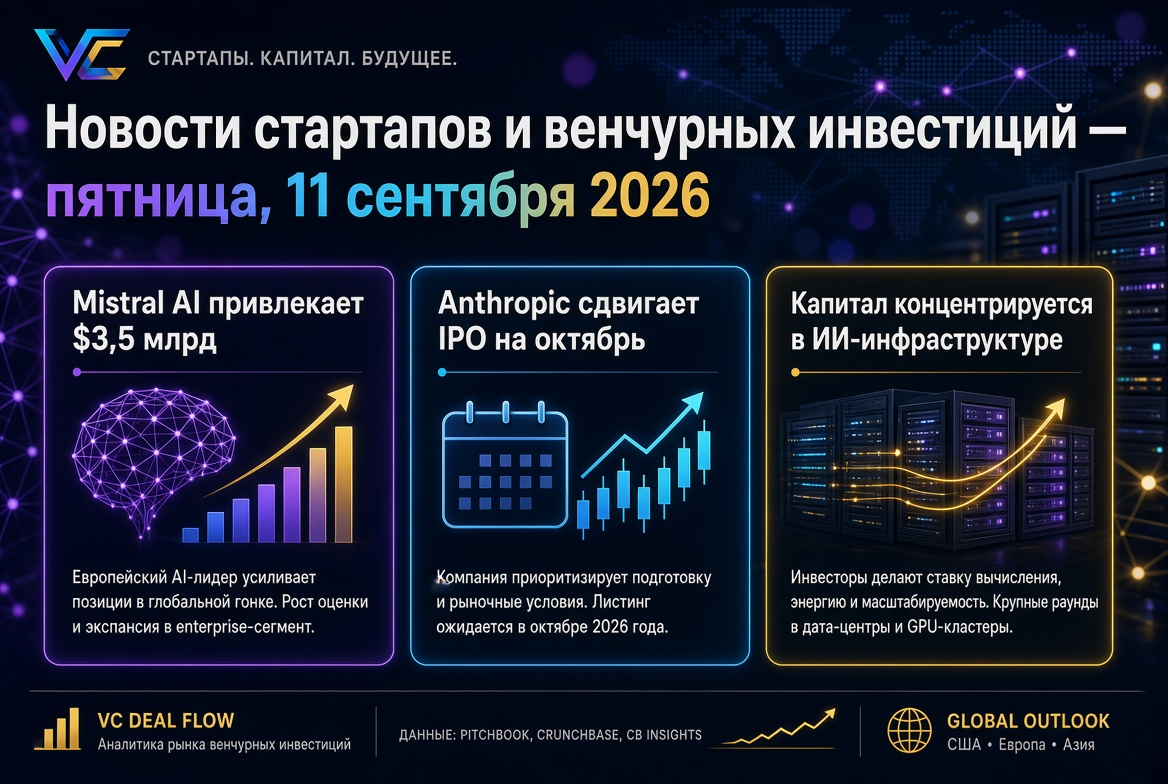
The artificial intelligence sector remains the main driver of the current venture upturn, showcasing unprecedented funding volumes. Since the beginning of 2025, AI startups in the U.S. have collectively raised over $160 billion, accounting for about two-thirds of all venture fund investments in the country. Analysts estimate that by the end of the year, global investments in AI companies could exceed $200 billion — a level previously unseen in the industry. The combined valuation of the top ten AI startups (including OpenAI, Anthropic, xAI, and others) has approached a staggering $1 trillion.
The influx of capital into AI is accompanied by the emergence of a multitude of new "unicorns" and a high concentration of investments. The bulk of the funds is directed towards a narrow circle of industry leaders, receiving the largest rounds. Approximately 70% of all venture investments in American startups recently have been concentrated on just a few of the most sought-after companies.
For instance, French startup Mistral AI set a record for Europe by raising about $2 billion, while American OpenAI secured $13 billion in a single round of financing. Recently, Elon Musk's xAI attracted investor support amounting to $15 billion (valuation ~ $200 billion), further fueling the race for AI megarounds. Such massive deals escalate company valuations to astronomical levels. Nevertheless, the venture market benefits from this surge of activity: capital and talent are concentrating around promising directions, which promises breakthrough innovations in the future, even if some of the financed projects ultimately do not meet expectations.
In recent weeks, several startups have announced significant funding rounds, reinforcing the return of "big checks" to the market:
- xAI (USA) — Elon Musk's startup raised $15 billion (valuation ~ $200 billion) for the development of advanced AI models and the procurement of graphics processors for training neural networks.
- Cursor (USA) — secured $2.3 billion in a Series D round at a valuation of $29.3 billion to expand its AI assistant platform for programming.
- CHAOS Industries (USA) — raised $510 million in financing to scale production of next-generation autonomous defense systems.
Revival of IPOs and Exit Prospects
Against the backdrop of rising valuations and a capital influx, tech companies are once again eyeing public markets. After a lull in the last two years, a revival of IPOs as a long-awaited exit path for venture investors has emerged. Earlier in 2025, some major unicorn startups successfully went public: for instance, the issuer of the stablecoin Circle conducted an IPO with a valuation of around $7 billion, while cryptocurrency exchange Bullish raised ~$1.1 billion through a listing, reaching a market cap of approximately $5–6 billion. These debuts demonstrated that there is renewed market appetite for new public offerings, especially in the fintech and cryptocurrency segments.
Now, major players are eager to take advantage of the newly opened "window" of opportunities. According to insider information, OpenAI, the creator of ChatGPT, is considering an initial public offering in 2026 with a potential valuation of up to $1 trillion. In the blockchain industry, wallet developer MetaMask, ConsenSys, has hired banks JPMorgan and Goldman Sachs to prepare for an IPO, planned for 2026. If it occurs, this will be the first public offering of such a large company from the Ethereum ecosystem — a landmark event for the entire crypto industry.
Improvements in market conditions and a gradual clarification of regulatory requirements also add confidence to startups planning a listing. As a result, the largest private companies are once again viewing the public market as a viable opportunity to attract capital and provide liquidity to investors. Experts predict that the number of high-profile tech IPOs will increase in the coming couple of years as the "window" for exits remains open and market multiples favor high valuations.
Beyond AI: Healthcare, Climate, Space, and Defense
Despite the dominance of AI, significant funds are also being directed towards other high-tech sectors. For example, healthcare and biotechnology attracted about $15 billion in venture capital in the third quarter of 2025 (ranking third after AI and IT infrastructure). The synergy of technology and medicine is reflected in major rounds such as the genomic medicine project Fireworks AI, which raised $250 million for the development of a platform at the intersection of AI and healthcare. Investors are also showing interest in climate and "green" innovations — from biodegradable materials made from algae to components for electric vehicles — although the scale of such deals currently falls short compared to the massive rounds in AI.
There is also a growing focus on space, defense, and other hard-tech areas. In Europe, for example, satellite startup EnduroSat raised over $100 million (with participation from funds like Google Ventures and Lux Capital) to expand the production of small satellites in response to the demand for affordable communication means in space. Overall, deep-tech sectors are experiencing a resurgence: in 2025, robotics, semiconductor, and quantum computing manufacturers collectively received funding in the tens of billions of dollars. While these volumes may not match the phenomenon of AI, venture capital is becoming increasingly diverse — reducing the risk of overheating in individual niches and promoting balanced technological progress.
Consolidation and M&A: Megadeals Reshaping the Landscape
High startup valuations and fierce competition are spurring a new wave of consolidation in the industry. Major mergers and acquisitions are once again taking center stage, reshaping the balance of power in the market. Strategic M&A helps corporations and investors accelerate growth, gain access to new technologies, or enter adjacent markets, while large acquisitions provide venture funds with much-needed exits.
For example, in October, investment bank Goldman Sachs announced the acquisition of venture firm Industry Ventures for nearly $1 billion. This deal marked one of the largest acquisitions in the venture sector, reflecting the growing interest of banking capital in technology and startup assets. Major technology corporations have also ramped up acquisitions, taking advantage of stable valuations: over the past year, several industry leaders have acquired promising startups to strengthen their positions in key areas (AI, cybersecurity, etc.). The wave of consolidation is also impacting the crypto industry: traditional financial companies are showing increased interest in acquiring blockchain startups. According to media reports, Mastercard is in talks to acquire several crypto projects (including infrastructure startup ZeroHash) for nearly $2 billion, aiming to establish a foothold in the digital asset space. The uptick in M&A — from bank investments in venture platforms to tech megadeals — points to the "maturation" of the market and offers startups more options for successful exits and integration into larger businesses.
Renewed Interest in Crypto Startups
After an extended "crypto winter," the market for blockchain startups is coming back to life: in October 2025, funding for crypto startups reached a peak not seen in recent years. In that month, projects attracted several billion dollars in investments (more than $20 billion since the beginning of the year). Leading venture funds (such as Sequoia Capital and Andreessen Horowitz) participated in the largest October rounds, signaling a return of confidence in the sector.
The rise in digital asset valuations (with Bitcoin exceeding the historic threshold of $100,000 in November) and the gradual clarification of regulations also fuel the interest of venture investors. Blockchain projects are once again attracting significant funds and attention from both venture funds and large corporations. This revival can essentially be termed a "renaissance" of crypto investments following a period of downturn, although market participants continue to exhibit selectivity and caution.