Key Startup and Venture Capital News for October 22, 2026: OpenAI's Capital Race, Mega Rounds for Ramp and Modal, New Unicorns Pigment and Daytona, IPO Preparations, and Venture Fund Activity in Europe, Asia, and the CIS
The venture market is entering the last decade of October 2026 with a rare concentration of capital. The largest private companies in the world are competing for investor funds ahead of the anticipated IPO of Anthropic, while the infrastructure layer of artificial intelligence continues to be overvalued at an unprecedented rate. In the 30 days leading up to October 18, startups around the globe announced approximately 600 funding rounds with a total disclosed volume of around $32 billion. For venture investors and funds, the key question of the week is where the line is drawn between justifiable growth premiums and overheating valuations.
Key themes of the day for investors:
- OpenAI accelerates round at ~$30 billion with a valuation of about $1.4 trillion pre-money — ahead of Anthropic's market debut.
- Mega rounds in fintech and AI clouds: Ramp valued at $60 billion, Modal at $15.75 billion.
- New unicorns: Pigment, Daytona, and Arda have joined the club of companies valued at over $1 billion.
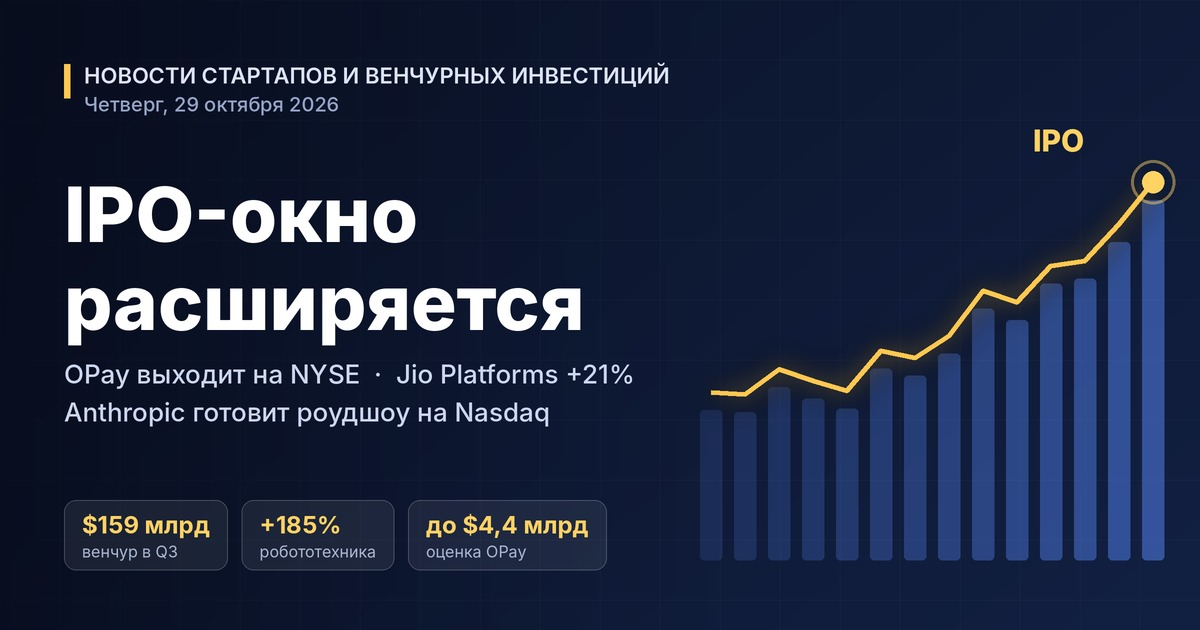
- IPO window: biotech in the US, record placement by Jio Platforms in India, and retracting applications from weak issuers.
- Defense technologies and biotech strengthen their positions as the second most significant areas for venture investments.
1. OpenAI vs Anthropic: The Race for Capital Ahead of the Year’s Main IPO
The central theme for the venture market is OpenAI’s desire to secure a new valuation before the public debut of its main competitor. According to sources familiar with the situation, the company is in accelerated fundraising of around $30 billion with a valuation of approximately $1.4 trillion before accounting for new money. Negotiations involve SoftBank, Abu Dhabi's MGX, and other existing shareholders.
Why This Matters to Investors
- The last valuation for OpenAI was $852 billion following a record round of $122 billion in March 2026. The new threshold suggests a growth of about 64% in seven months.
- The company itself set the round’s price, departing from the classic negotiation model with a lead investor.
- The public offering of OpenAI has been postponed at least until 2027, so this round effectively serves as a “bridge” to the IPO.
- OpenAI’s annual revenue during the summer exceeded $40 billion.
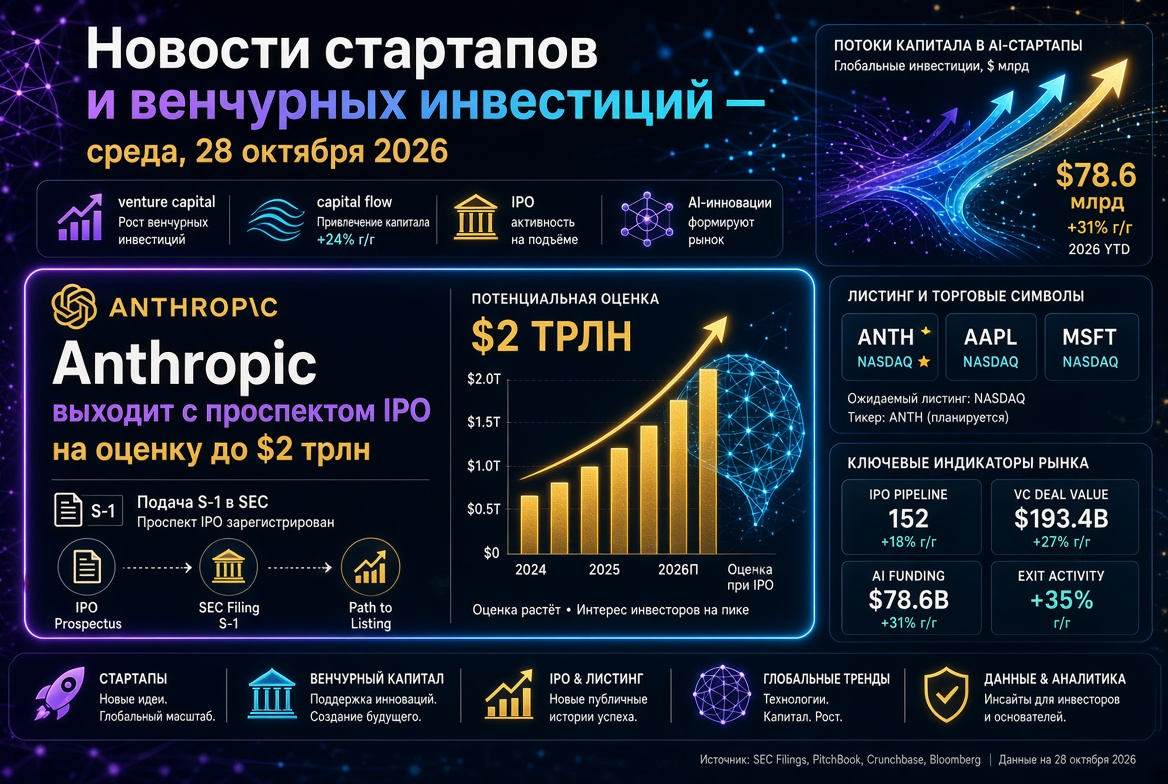
Simultaneously, a portion of Anthropic's investors, according to reports, are discussing a target of around $1.5 trillion for the anticipated public debut in mid-November. For the entire market, this means the establishment of a public benchmark from which late-stage AI company valuations will be derived.
2. Ramp: A Fintech Unicorn Worth $60 Billion
The corporate expense management service Ramp secured about $1.85 billion at a valuation of approximately $60 billion pre-money. The round was led by Dragoneer Investment Group and Thrive Capital, with a significant check also written by Founders Fund. Back in June, the company was valued at $44 billion.
- Client base — over 70,000 companies.
- Growth strategy — integrating AI agents into financial processes and potential training of proprietary models.
- Context: the main competitor, Brex, was sold to Capital One for $5.15 billion in 2026, marking Ramp as an undisputed leader in the independent segment.
3. AI Infrastructure: The Fastest Growing Asset Class
The artificial intelligence infrastructure layer remains the main magnet for venture capital. Investors are paying premiums not for chatbots but for computation, cloud services, and tools for AI agents.
Modal: Valuation Increased 3.4 Times in Five Months
The cloud platform Modal closed a Series D round at $750 million with a valuation of $15.75 billion post-money. Accel led the round, with Kleiner Perkins and all existing shareholders participating. The company’s annual revenue run rate exceeded $1 billion, while in May, during the Series C round, the valuation was at $4.65 billion.
Daytona: “Cloud for Agents” Becomes a Unicorn
The startup Daytona raised $60 million in a Series B round at a valuation of $1 billion. The company is building a specialized cloud environment where AI agents receive isolated “sandboxes” to operate within several milliseconds.
Inference Chips
According to industry analytics, the median valuation of AI chip developers’ startups has increased approximately nine-fold over the last two years. This raises the bar for future exits and heightens the risk for funds entering late-stage investments.
4. New Unicorns and Applied AI
Beyond infrastructure, venture funds are actively financing applied AI solutions for the corporate sector and industry.
- Pigment (France) — $250 million at a valuation of $2.3 billion; the round was led by Scaleup Europe Fund with participation from Nvidia. The annual recurring revenue surpassed $100 million and doubled over the year.
- Arda (USA) — $230 million at a valuation of $1.5 billion from Altimeter Capital, Accel, and Khosla Ventures. The company, founded by former OpenAI research lead Bob McGrew, automates production line design.
- Different (USA) — $48 million in seed funding for an AI-based full-cycle marketing system.
- Leena AI — a strategic investment from IBM Ventures in an AI agent for HR, IT, and finance.
5. Fintech and Stablecoins: Infrastructure for the "Bot Economy"
The fintech segment demonstrates consistent activity in early stages:
- Mural — $15 million in Series A led by Tether for a platform integrating fiat currencies and stablecoins.
- ScribeUp — $13 million for banks looking to control customer recurring payment management.
- Fragment — $12 million for automating financial operations for vertical AI companies.
- Prism Data — $20 million for credit scoring based on open banking data.
6. Biotech and Defense Technologies: An Alternative to AI Concentration
Biotech
- Swiss Nouscom — $135 million in Series D with participation from M Ventures and the European Investment Bank.
- Estuary Biotherapeutics — $93 million in Series A led by RA Capital Management for gene therapy for kidney diseases.
Defense Technologies
- Destinus acquired the Dutch startup Perciv AI, which develops radar perception for GNSS-denied conditions.
- British Skyfly raised $10 million in a seed round for a hybrid drone.
- According to industry surveys, nearly all UK defense companies are expecting to attract external capital.
7. IPO Market: Window Open, But Selectively
Public markets remain accessible for quality issuers; however, investors are rigorously filtering out weak stories.
- Lycia Therapeutics is preparing for an IPO on Nasdaq of around $250 million at a price range of $16–18 per share; trading is expected at the end of the week.
- Jio Platforms is conducting the largest IPO in Indian history: subscriptions are open from October 21 to 23, with listing planned for October 28.
- Klook has withdrawn its application for an American IPO of approximately $400 million, while several smaller issuers have reduced the size of their offerings.
8. Russia, CIS, and Europe: Local Venture Agenda
- Indie GO Fund II — a new Russian fund for gaming studios with a target volume of 5 billion rubles; the first closing is planned for Q4 2026, with a strategy focused on subsequent IPOs of portfolio companies.
- Moscow Venture Fund has signed agreements with tech companies for 250 million rubles, with an expected co-investment volume of around 1 billion rubles.
- Paidax (Kazakhstan) — $1 million with participation from DOMiNO Ventures; the platform has been authorized for trading digital assets on KASE.
- Europe: Spanish Enzo Ventures closed its second fund at €20 million for pre-seed deals, while the growth team from Partech has spun out into an independent investment firm.
9. What This Means for Venture Investors and Funds
The startup and venture investment market in October 2026 is moving along the trajectory of a "power law": capital is concentrating within a narrow circle of AI leaders, and valuations of infrastructure companies are being revised upwards in mere months. For funds, this creates several practical takeaways:
- Valuation discipline becomes a key factor in returns: entry multiples for late-stage investments already embed years of flawless growth.
- IPO of Anthropic will serve as a benchmark for reevaluating the entire AI sector — both towards growth and correction.
- Diversification into biotech, defense technologies, and fintech reduces portfolio reliance on a single theme.
- Early stages remain the area of greatest asymmetry: this is where the future unicorns of applied AI are being formed.
In the coming weeks, investors' attention will be drawn to the closing of OpenAI's round, the parameters of Anthropic's placement, and the outcomes of Jio Platforms' listing — three events that will determine the mood of the global venture market as we close out 2026.